
#1 Ascoltare l'Invisibile / Talk & Concert
Francesco Gottardo, Salah El Ouergli, Ouail El Azhari
Kunstverein Milano and Fondazione Galleria Milano are launching a joint research project dedicated to non-ordinary states of consciousness, understood as cross-cutting experiences — from trance to dreams, from ritual to sound technologies and the use of psychoactive substances — as tools for navigation and new opportunities for expression. Artists, researchers, musicians, philosophers, writers and scholars from diverse backgrounds will take centre stage in a series of meetings, screenings, listening sessions, collective practices and publications, held both on a regular basis and on an ad hoc basis.
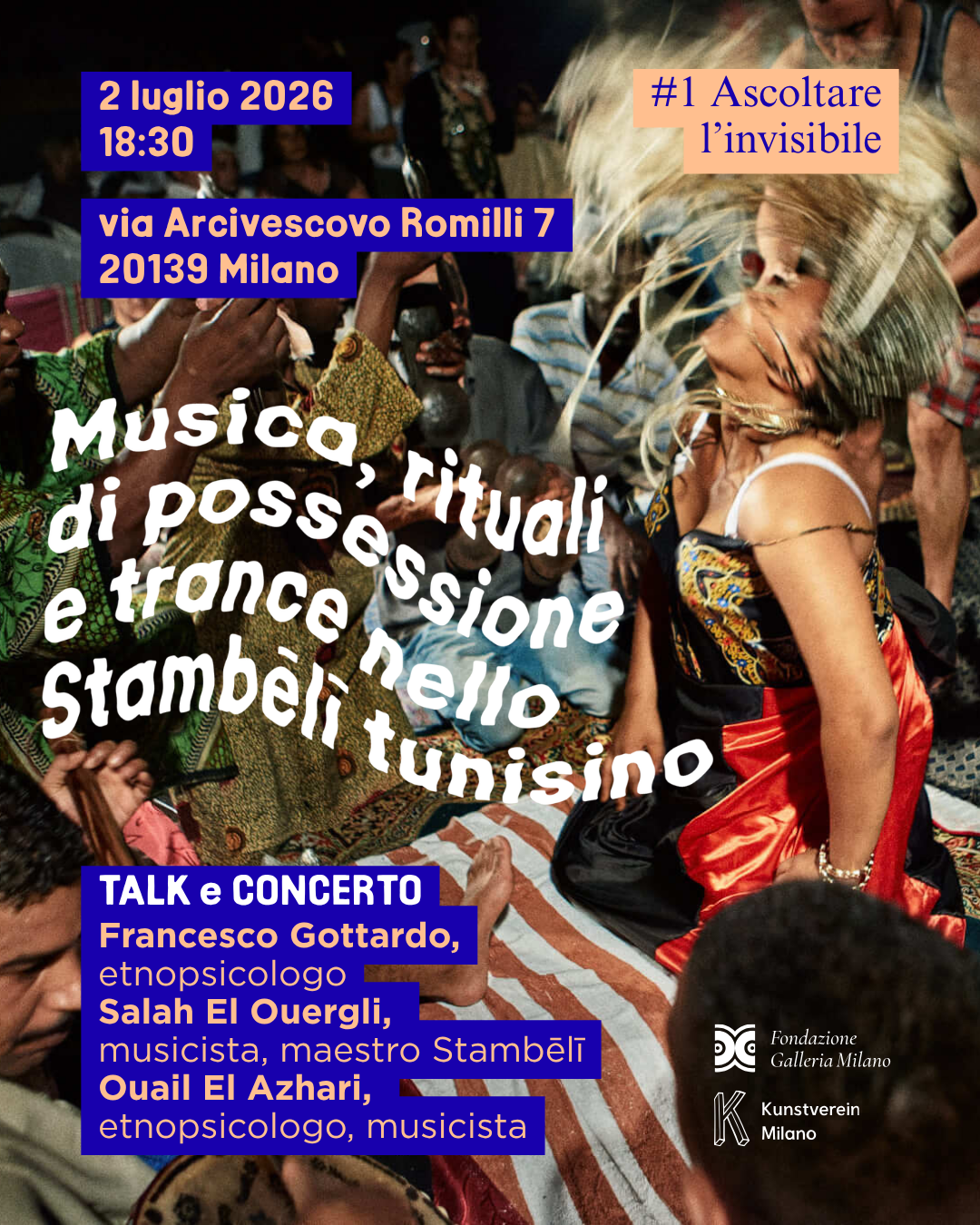
02.07.2026
@Fondazione Galleria Milano
The first event in the programme begins with a question: why do we talk about trance? And why, in traditional contexts, is it so often associated with music?
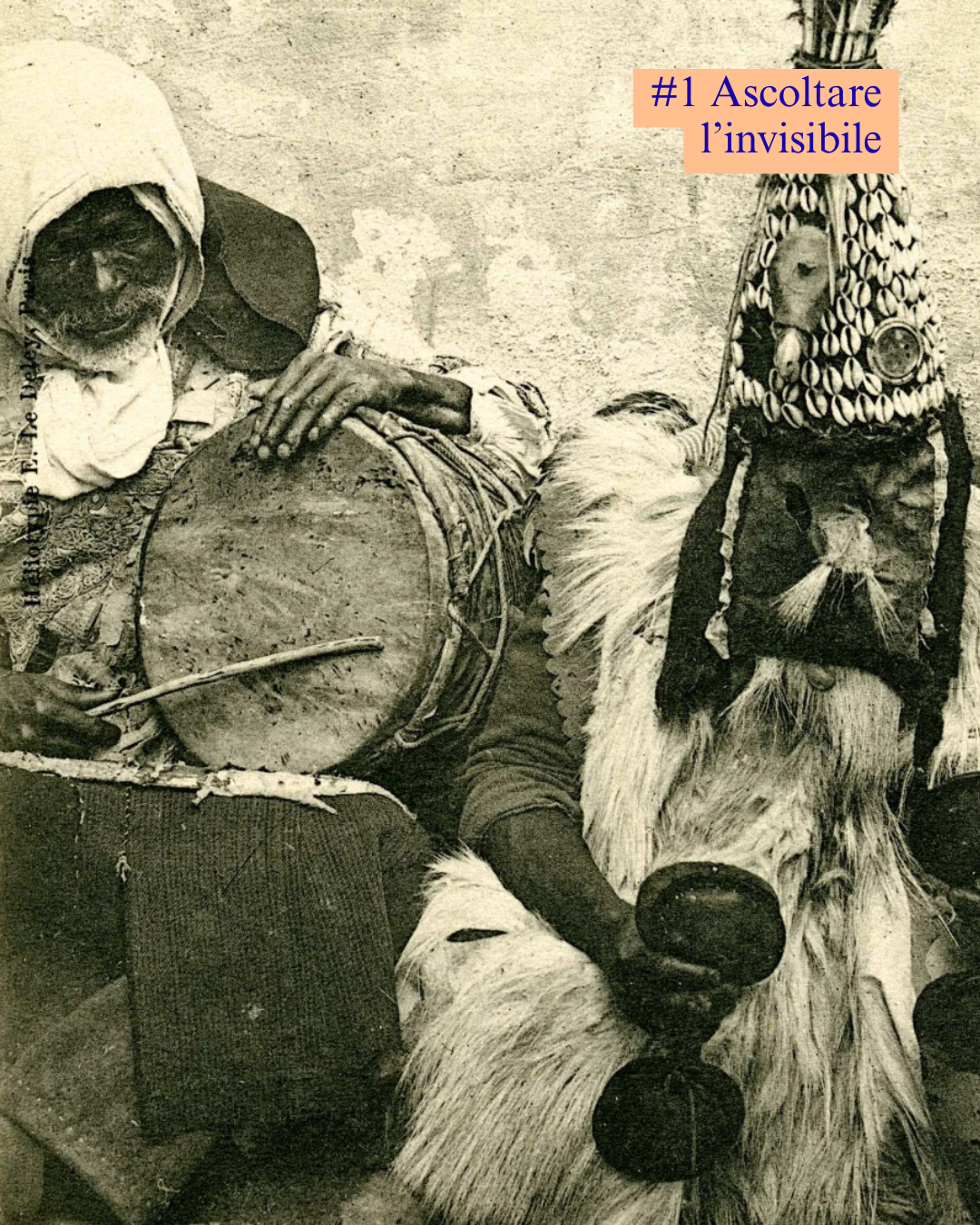
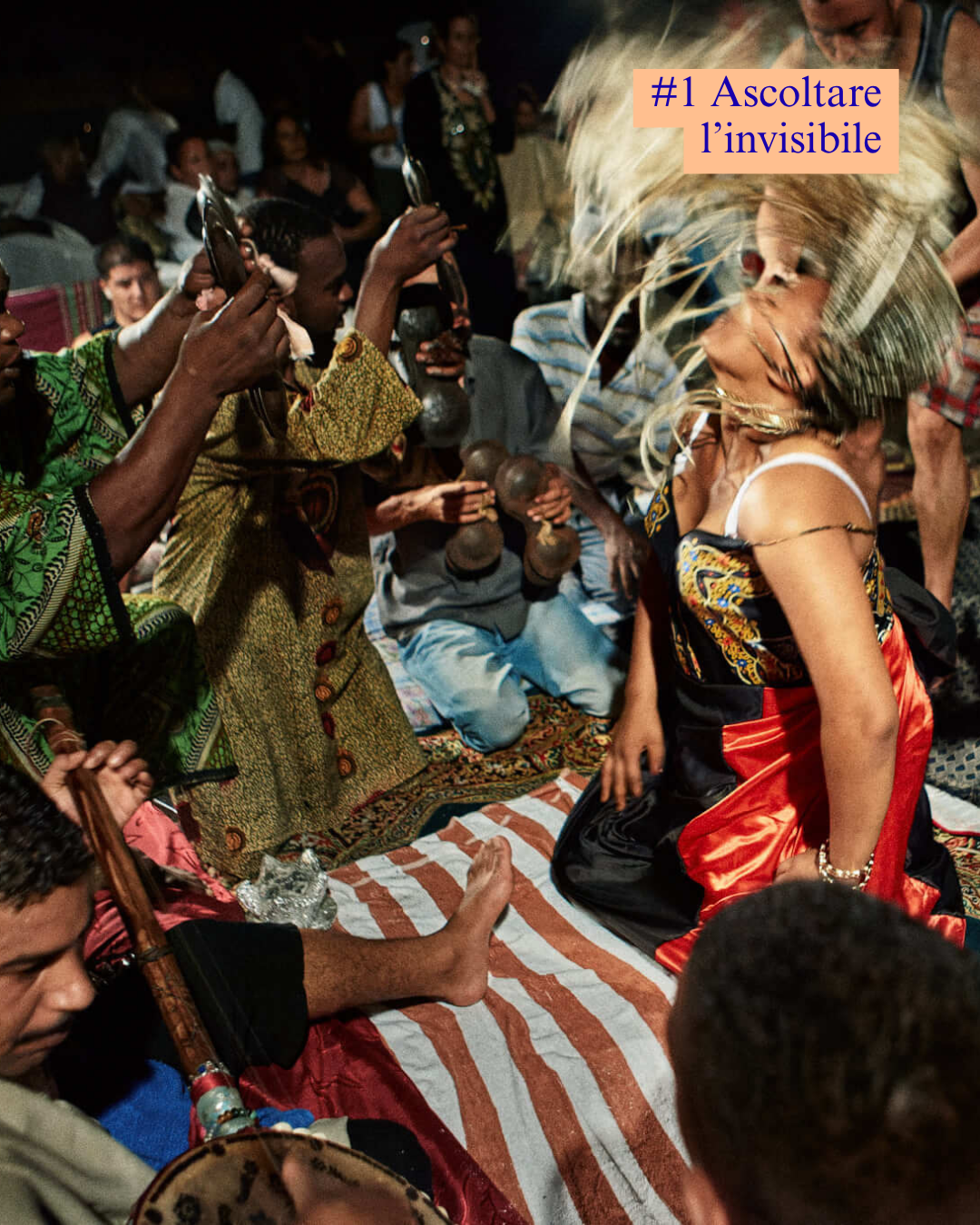
Building on these questions, the event on 2 July is dedicated to Stambēlī, a musical, ritual and therapeutic tradition that developed in Tunisia within communities of African descent formed through the trans-Saharan slave routes. Its roots lie in the cultures of Lake Chad, the Bornu and Sahel regions of West and Central Africa, and include legacies traceable to the Hausa, Songhay and other sub-Saharan peoples who, through forced migration and diasporic processes, contributed to the development of new cultural forms in the Maghreb.
Stambēlī still constitutes a complex system of relationships between music, the body, healing and the invisible world. Its pantheon is organised around two broad categories: the ‘Whites’, saints associated with Islam, North Africa and the Middle East, and the ‘Blacks’, ancestral spirits originating from African diasporic cosmologies. It is an embodied and performative system of knowledge: there are no written texts or recited formulas describing the pantheon; it exists solely through musical performance, in which music continually produces, reproduces and reorganises the entire system of saints, spirits and relationships. Musicians must master not only the melodies, but also the social, hierarchical and ritual relationships between the various spiritual presences. A thorough understanding of the spirits and their mutual relationships is often more important than detailed knowledge of the patient’s suffering: knowing which spirit is involved already means knowing which musical paths will be effective in summoning it, appeasing it and ensuring the ritual’s success.
The Stambēlī is also an embodied historical archive — a ‘third space’ in which music, healing, historical memory, the African diaspora and social relations are simultaneously produced through bodily experience. Individual healing and historical memory are inseparable: one cannot be understood without the other.
The power of the Stambēlī lies in the psychophysical engagement it generates, taking the form of what Rouget defines as a ‘sonic uniform’ — a combination of melody, rhythm and words perceived through ritualised trance and possession. It is its ability to continually reorganise itself — to transform, reinterpret and reconfigure itself — that keeps the practice alive and meaningful.
Our thanks to the Trickster Collective for their collaboration.
Guests
Salah El Ouergli lives in Tunis, where for decades he has devoted himself to the Stambēlī, serving as the yenna, or master of the tradition. In addition to his performing activities, he is involved in the construction of the musical instruments specific to this practice.
Ouail El Azhari, an ethnopsychologist, lives and works in Turin. For years he has devoted his research to Gnawa, a tradition whose historical and musical heritage he has promoted through the Gnawa Koyo project.
Francesco Gottardo, an ethnopsychologist, lives and works in Turin. His research explores the frontiers of the psyche — death, altered states of consciousness, magic — and he is a member of the Trickster Collective
Team del progetto di ricerca Ascoltare L'invisibile / Research project team Listening to the Invisible
Katia Anguelova , Andrea Wiarda (Kunstverein Milano)
Nicola Pellegrini, Bianca Trevisan (Fondazione Galleria Milano)
Rete di affinità / Network of affinities
La ricerca fa parte di un lavoro condiviso e di alleanza con: Carico Massimo, Livorno, La Fondazione Lac o le Mon, il gruppo Indicibile. / The research forms part of a collaborative endeavour and partnership with: Carico Massimo, Livorno; Fondazione Lac o le Mon; and the Indicibile group.